
A fall inside a grocery store, office building, restaurant, shopping centre, or apartment lobby doesn’t automatically make one party responsible. Some incidents stem from hazards that staff ignored. Others involve maintenance contractors, snow removal companies, or tenants who controlled the space where the incident happened. That’s why lawyers start with one question: Who had control over the area where you fell?
You determine liability after a commercial property fall by identifying who controlled the property, proving they failed to take reasonable care, and showing that their failure caused your injuries. If you’ve been hurt in Edmonton, speaking with a slip and fall attorney early can help preserve evidence before it disappears and clarify who may bear legal responsibility.
In Alberta, liability depends on facts, documentation, and the legal duties imposed under provincial legislation. The answer isn’t always obvious, especially if multiple parties shared responsibility for maintaining the premises.
Who Can Be Liable After a Commercial Property Fall?
- Business leasing retail space
- Commercial landlord
- Shopping centre management company
- Restaurant operator
- Maintenance contractor responsible for inspections
- Snow and ice removal contractor
- Property owner who still controls common areas
Alberta Law Focuses on Reasonable Care, Not Perfect Safety
People sometimes believe a business becomes automatically responsible any time someone falls. Alberta law doesn’t work that way.
The Occupiers’ Liability Act asks a different question: Did the occupier take reasonable steps to protect visitors from foreseeable harm?
Reasonable care depends on the circumstances. For example, a grocery store cannot stop every spill the second it happens. It can:
- Train employees to inspect aisles regularly.
- Clean spills quickly.
- Place warning signs around temporary hazards.
- Record inspections.
- Respond to customer complaints without delay.
A court looks at what happened before the incident, not simply the outcome.
The same analysis applies outdoors during Edmonton winters. Fresh snowfall doesn’t instantly create liability. A business receives a reasonable opportunity to clear snow or treat ice. But if an icy sidewalk remains untreated for hours or days despite repeated complaints, the analysis changes.
Evidence showing the occupier failed to inspect, repair, or warn visitors can become central to an Alberta slip and fall claim.
What Must You Prove to Hold Someone Liable?
Successful slip and fall accident claims require more than proof that you were injured. Your lawyer generally needs to establish four elements.
1. A Duty of Care Existed
Commercial businesses owe lawful visitors a duty under Alberta’s Occupiers’ Liability Act. Customers entering a shopping mall, hotel, clinic, restaurant, or office building expect staff to identify hazardous conditions within a reasonable time.
2. The Duty Was Breached
Next comes proof that the occupier failed to meet that standard. Examples include:
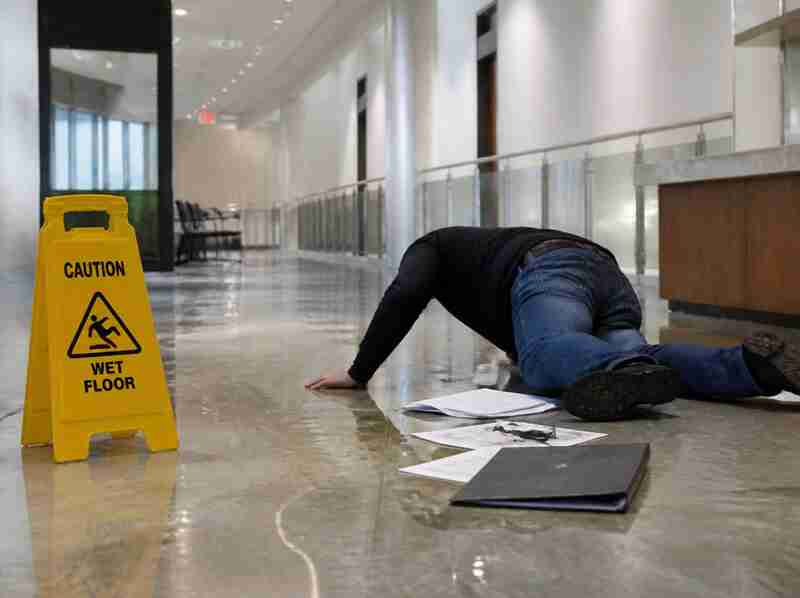
- Ignoring wet floors after staff noticed a spill
- Leaving a slippery surface untreated
- Failing to repair broken flooring
- Allowing poor lighting in stairwells
- Neglecting routine inspections
- Failing to warn visitors about temporary hazards
- Ignoring obvious potential risks
The court compares the business’s actions against what a reasonable occupier would have done under similar circumstances.
3. The Hazard Caused the Fall
There must be a direct connection between the unsafe condition and the accident.
- If surveillance video shows you slipping immediately after stepping into an unmarked spill, that evidence becomes highly persuasive.
- If no dangerous condition existed before the incident, proving liability becomes much harder.
4. You Suffered Compensable Losses
The final element involves demonstrating real damages. That may include:
- Physical injuries
- Income losses
- Treatment costs
- Long-term disability
- Pain and suffering
Medical documentation plays a major role from the beginning of the claim.
Evidence Can Make or Break Your Case
- Photos of the hazard
- Video of the surrounding area
- Contact details for witnesses
- Incident reports completed by staff
- Receipts showing you were on the premises
- Clothing and footwear worn during the incident
How About Medical Evidence?
Yes, it matters just as much. Always seek medical attention, even if your symptoms seem minor. Some injuries don’t appear immediately. Your medical records create an objective timeline linking the accident to your condition. According to Alberta’s Injury Prevention Centre, the province recorded an average of 15,235 fall-related hospital admissions each year between 2003 and 2022, accounting for 45% of all injury-related hospital admissions. The same report found that 45% of fall-related emergency department visits lacked enough documentation to identify a more specific cause, which makes early documentation especially valuable after a commercial fall.What Types of Injuries Strengthen a Commercial Fall Claim?
No lawyer wants to judge slip and fall cases by the severity of an injury alone. Liability comes first. Still, the extent of your slip and fall injuries affects the value of your personal injury claim and the evidence needed to support it. Commercial falls can cause:- Soft tissue injuries affecting the neck, shoulders, or back
- Broken bones, especially wrists, hips, and ankles
- Torn ligaments requiring surgery or rehabilitation
- Traumatic brain injuries after striking the head
- Spinal cord injuries with permanent mobility issues
Liability Isn't Always Limited to One Party
Commercial properties involve multiple businesses working together. That’s one reason liability disputes become complicated.
Take an Edmonton office building. The landlord hires a property management company, which hires a cleaning contractor. A visitor slips on freshly mopped tile with no warning cones in place.
Who bears responsibility?
The answer depends on the facts.
A lawyer may examine:
- The lease agreement
- The cleaning contract
- Maintenance schedules
- Inspection records
- Security footage
- Staff training policies
The cleaning contractor may have created the hazard.
The management company may have failed to supervise the contractor.
The landlord may still control common areas under the lease.
Canadian courts have repeatedly emphasized that responsibility follows control of the premises. Lord Denning, a famous and influential English judge of the 20th century, in Wheat v. Lacon, [1966] A.C. 552, said:
“If a person has any degree of control over the state of the premises, it is enough.”
“In order to be an occupier it is not necessary for a person to have entire control over the premises. He need not have exclusive occupation. Suffice it that he has some degree of control. He may share the control with others. Two or more may be occupiers. And whenever this happens, each is under a duty to use care towards persons coming lawfully onto the premises, dependent on his degree of control. If each fails in his duty, each is liable to a visitor who is injured in consequence of his failure, but each may have a claim to contribution from the other.”
A business cannot avoid liability simply by outsourcing maintenance if it still retains responsibility for safety inspections.

Injured after a commercial property fall in Edmonton? Get answers before valuable evidence disappears. Speak with a legal team that knows how to identify every responsible party and protect your rights.
What Happens if You Were Partly Responsible?
A business may argue that you contributed to the accident. Examples include:
- Ignoring clearly posted warning signs
- Running through a freshly cleaned area
- Wearing unsafe footwear during severe winter conditions
- Entering a restricted maintenance zone
But that doesn’t automatically end your claim.
Under Alberta’s Contributory Negligence Act, courts can divide responsibility between the parties. If the court decides you were 20% responsible and the occupier was 80% responsible, your damages may be reduced by your share of fault.
This is one reason experienced legal representation matters. Insurance adjusters sometimes overstate a visitor’s responsibility during settlement discussions.
What if the Insurance Company Denies Responsibility?
A denial doesn’t mean your case lacks merit. An insurance company may argue:
- The hazard appeared moments before the incident.
- Staff had no reasonable opportunity to correct it.
- You caused your own injuries.
- The accident happened on someone else’s portion of the property.
- Your injuries existed before the fall.
An experienced lawyer responds with evidence, not assumptions. That could include surveillance footage, inspection logs, expert reports, witness testimony, weather records, and medical documentation connecting the accident with your resulting injuries. If negotiations fail, filing legal action may become the next step.
Don't wait for evidence to disappear. Our skilled legal team reviews commercial property falls, explains your legal options, and helps you pursue the compensation your recovery deserves.
Why Early Legal Advice Makes a Difference
Commercial property claims move quickly. Surveillance footage may be overwritten within days, witnesses become harder to locate, and maintenance records can change as repairs take place.
Speaking with Edmonton slip and fall lawyers that locals recommend early gives you the opportunity to preserve evidence in a timely manner. Most firms, including Sidhu Personal Injury Lawyers, offer a free initial consultation, so you can receive a legal opinion about your case before deciding your next step.
A slip and fall lawyer will review who controlled the property, identify every potentially responsible party, and explain the legal process from start to finish. If your injuries affect your ability to work or enjoy daily life, your lawyer can calculate your financial losses and pursue a fair settlement that reflects the full impact of the accident.