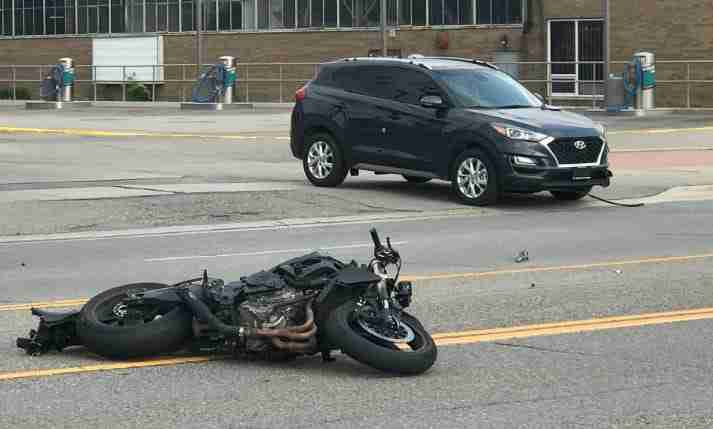
Motor vehicle accidents are a main factor of injury and death globally. While most accidents fall under civil law, where negligence determines compensation, some can have criminal repercussions.
Understanding the distinction between these two legal areas is essential, especially for a motorcycle accident victim who wants to pursue a motorcycle accident case and get maximum compensation.
To know if a motorcycle accident is a crime, let a motorcycle accident attorney assess the personal injury case and seek compensation according to the law.

Differentiating Criminal vs. Civil Cases
| Elements | Civil Case | Criminal Case |
| Parties Involved | Involve private parties (individuals, organizations, or businesses) in a dispute. The plaintiff and the defendant | Involve the State prosecuting an individual or entity for violating criminal law. |
| Standard of Proof | Have a “preponderance of the evidence” standard. Plaintiff must present evidence to convince the judge that their personal injury claims are valid | Utilize a stricter “beyond a reasonable doubt” standard. Need to present convincing evidence to protect motorcycle riders from wrongful convictions |
| Purpose and Outcome | Aim to resolve disputes to the motorcycle accident victims. Include monetary damages (for lost wages, future costs of treatment, pain and suffering), or court orders | Lawyers focus on upholding the law and punishing offenders. Include incarceration, fines, probation, community service, or restitution (payment to motorcycle accident victims for lost income and other damages). |
| Procedural Differences | Less stringent. Trials can be civil jury trials or bench trials (judge-decided) | Stricter procedures. Trials are jury trials, though defendants can forfeit their right to a jury trial and hope for a bench trial. |
Motorcycle Accidents and Criminal Charges
Driving Under the Influence (DUI)
In Alberta, impaired driving is a criminal offence governed by the Criminal Code of Canada. Section 253 of the Criminal Code outlines the legal aspects for DUI, with specific blood alcohol concentration (BAC) thresholds and associated penalties.| Blood Alcohol Concentration (BAC) Limits | Operating a motor vehicle with a BAC exceeding 0.08% constitutes a DUI offence. |
| Penalties for DUI |
|
| Impaired Driving by Drugs | Driving under the influence or certain prescribed medications result in criminal charges. The law use field sobriety testing and drug recognition expertise (DRE) evaluations to assess drug impairment. |
Reckless Driving and Criminal Negligence
- Speeding above the posted limit, particularly in high-risk zones, constitutes reckless driving.
- Engaging in organized competitions or street racing on public roads is a severe offence with criminal consequences.
- Ignoring traffic laws poses a significant threat and is classified as reckless driving.
- Texting while driving, using handheld devices, or engaging in other distracting activities increases risk of motorcycle crashes and may be considered reckless driving.
Hit-and-Run Accidents
Under the Criminal Code of Canada, leaving the scene of an Edmonton motorcycle accident, especially one involving serious injuries or property damage, is a crime.- Following an accident, all drivers involved are legally obligated to remain at the accident scene, to exchange information with other drivers or parties and report the accident to the police.
- Leaving the scene of an accident is viewed as an admission of guilt and leads to harsher penalties.
- If a hit-and-run accident results in injuries or death, the charges become even more severe, including aggravated assault or manslaughter.
Wrongful Death
When an accident results in a fatality due to another driver’s negligence, wrongful death lawsuits may be filed by the deceased’s family under the Fatal Accidents Act. This is a separate civil action to recover compensation for damages such as loss of income, companionship, and funeral expenses.Fleeing from Police
Attempting to evade a lawful police stop is a criminal offence under Section 345 of the Criminal Code. This applies to situations where a driver suspects they may be under the influence or driving without a license. Fleeing from police leads to additional charges beyond the initial traffic violation.Failure to Remain at the Scene
The Duty to Remain
The Criminal Code of Canada (CCC) lays the foundation for criminal charges associated with failing to remain at the scene of an accident. The CCC mandates that “everyone who is the driver of a motor involved in an accident… shall forthwith” (without delay) take specific actions:- Stop their vehicle.
- Remain at the scene of the accident.
- Provide their name, address, and vehicle registration number to the person injured in a motorcycle accident or the owner of a property damaged in the accident.
- Do a police report and provide the accident date, their name, address, and vehicle registration number.
Charges and Penalties
Leaving the scene involving only minor property damage results in a provincial traffic violation with a corresponding fine. If the accident causes serious injuries (e.g., head injuries, spinal cord injuries), it can be result in serious criminal charges. The CCC allows for charges of “failing to remain at the scene causing bodily harm.” These charges carry penalties of:- Imprisonment
- License suspension
- Fines
- Criminal Negligence: Applies when the driver’s actions or inactions demonstrate a hinted departure from the standard of care of a reasonable person, resulting in death. Penalties include imprisonment for up to life.
- Manslaughter: Applies when the driver exhibits a willful neglect for the safety of others, leading to a fatality. Manslaughter convictions can result in a life sentence.
Role of Lawyers in a Motor Vehicle Accident
Motorcycle accident lawyers deeply understand tort law, the legal framework governing motorcycle accident claims arising from MVAs. They will assess the strength of your case, identify liable parties, and gather compelling evidence such as accident reports and witness statements for a motorcycle accident claim. Injury lawyers are adept at processing insurance policies and negotiating with the insurance company to ensure you receive the maximum possible settlement after a motorcycle crash. For personal injury cases requiring litigation, an experienced motorcycle accident lawyer can:- Draft and file legal documents: Create pleadings, motions, and other legal documents necessary for going through the court system and a personal injury claim
- Present evidence and arguments: Effectively presents evidence gathered during the investigation and advocates for your rights in court
- Negotiate settlements during litigation: Even during a lawsuit, settlement negotiations still occur in motorcycle accident cases. Motorcycle injury attorneys ensure fair settlement for the damages and injuries sustained.