
A spinal cord injury lawyer isn’t for every slip and fall. But if your body isn’t “bouncing back” the way it should, that’s your first clue you’re not dealing with a routine injury anymore.
Here’s the blunt reality: most falls don’t turn into legal cases. Two people can fall the same way and walk away with completely different outcomes. One recovers in a week. The other faces years of rehab, lost income, and permanent limitations. That difference? That’s what defines whether a case needs legal attention.
And if you’re already seeing signs stack up, that’s where Sidhu Personal Injury Lawyers Edmonton comes in. Sidhu lawyers can help you identify early whether your situation is heading toward long-term impact.
Why Severity Matters More Than the Fall Itself
Not all falls are the same. You could slip on a wet floor, stand up, and walk away. Or you could fall the exact same way and end up with life-altering nerve damage.
Here’s the key idea: it’s not the fall that triggers a legal case, it’s the impact of the injury.
- From a medical standpoint, spinal cord injuries (SCIs) happen when the spinal cord is compressed, bruised, torn, or severed. And the consequences depend heavily on where and how severe that damage is.
- From a legal standpoint, severity is what transforms a simple incident into a case worth reviewing.
And here’s an important reality check: Falls are one of the leading causes of spinal cord injuries, accounting for roughly 20–30% of cases globally. So yes, what seems like a “routine” fall can absolutely escalate into something legally significant.

You don’t need to be “paralyzed” to have a serious spinal injury. If your movement, strength, or balance changed, get it checked.
The First Threshold: Objective Medical Evidence of Spinal Damage
The first major trigger for a legal case review is simple: Is there medically verified damage to the spine or spinal cord?
This shows up as:
- Herniated or ruptured discs
- Vertebral fractures
- Spinal cord compression
- Nerve root impingement
Once imaging (MRI, CT scans) confirms structural damage, the case shifts from “complaint” to documented injury, which is critical in any personal injury claim. Without this, cases tend to stall early.
The Second Threshold: Neurological Symptoms That Don’t Resolve
This is where things get more serious. A fall becomes legally significant when it leads to neurological deficits, such as:
- Numbness or tingling in limbs
- Loss of coordination or balance
- Muscle weakness
- Partial paralysis
According to the World Health Organization (WHO), spinal cord injuries are defined not just by damage, but by loss of function below the injury site. If symptoms persist beyond the acute phase (days to weeks), it signals lasting impairment. These are key factors in compensation claims.
The Third Threshold: Functional Loss in Daily Life
Here’s where the conversation shifts from medical to real-life impact. Lawyers look closely at whether the injury affects your ability to:
Category of Impact | Specific Functional Limitations |
Professional & Financial | Inability to work, loss of earning capacity, or needing to change careers due to physical constraints. |
Physical Mobility | Difficulties with walking, lifting objects, climbing stairs, or performing basic movement tasks. |
Personal Independence | Loss of autonomy in “Activities of Daily Living” (ADLs) such as bathing, dressing, and driving. |
WHO also reports that spinal cord injuries are a major cause of long-term disability worldwide. It affects a person’s ability to carry out everyday activities. Once a fall interferes with daily functioning, it significantly increases the value (and urgency) of a case review.
The Fourth Threshold: Mechanism and Force of the Fall
Not all falls generate enough force to injure the spinal cord. But certain scenarios raise immediate red flags:
✓ Falls from height (stairs, ladders, buildings)
✓ Hard-surface impacts (concrete, tile)
✓ Sudden backward falls (risking cervical spine injury)
Research from The Academy of Spinal Cord Injury Professionals shows that higher-impact falls are more likely to cause severe or complete spinal injuries, especially in the thoracic region. That mechanism helps lawyers and medical experts connect the incident directly to the injury.
The Fifth Threshold: Long-Term or Permanent Consequences
This is usually the tipping point.
A case almost always warrants serious legal review when there is:
- Permanent disability
- Chronic pain or nerve damage
- Need for long-term rehabilitation or assistive care
Globally, over 15 million people live with spinal cord injuries, many requiring ongoing care and facing reduced quality of life. At this stage, the financial implications alone (medical costs, lost income, future care) make legal action not just viable, but necessary.
The Overlooked Factor: Negligence Still Has to Be Proven
Even if all severity thresholds are met, there’s one more piece: Was someone responsible?
Slip and fall cases hinge on proving that:
- A hazard existed (wet floor, uneven surface, poor maintenance)
- The responsible party failed to address it
- That failure directly caused the injury
Without this link, even severe injuries may not translate into a successful claim.
So, When Does a Case Get Reviewed?
In practical terms, experienced injury lawyers Edmonton step in when:
✓ There’s clear medical evidence of spinal damage
✓ Symptoms show neurological involvement
✓ The injury affects daily function or work capacity
✓ The fall involved significant force or risk factors
✓ And there’s a credible argument for negligence
That combination, not just the fall itself, is what crosses the threshold.
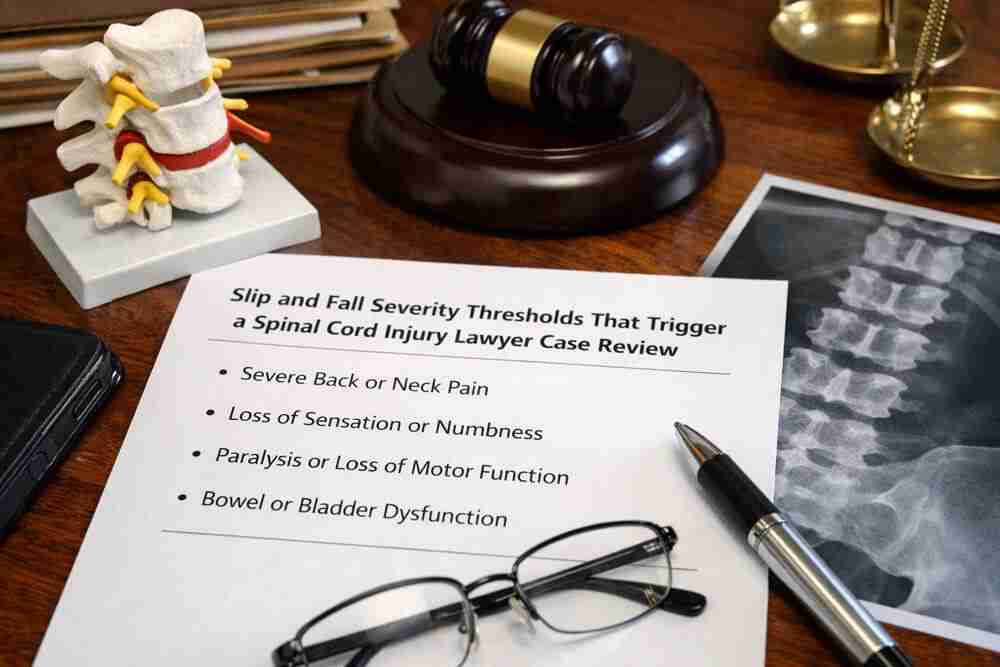
“It’ll Go Away” Isn’t a Strategy. Call Lawyers Today.
Most people don’t think a simple fall can change their life. But medically and legally, the line between “minor accident” and “serious case” is thinner than it looks. If a fall leads to spinal involvement, persistent symptoms, or real disruption to how you live and work, it’s no longer something to brush off. It’s something to evaluate properly.
That’s exactly where firms like Sidhu Personal Injury Lawyers Edmonton step in, right at that intersection of medical severity and legal accountability. Our proper case review doesn’t commit you to anything, but it does give you a clear picture of what you’re dealing with.
Frequently Asked Questions
How do spinal cord injury claims differ when the accident involves both a fall and a motor vehicle accident?
In these situations, spinal cord injury claims become highly technical because lawyers must separate or combine causation. The key question becomes: Did one incident cause the injury, or did both contribute? An experienced injury law firm will bring in medical experts to determine how each event impacted the spine and whether liability can be shared across multiple parties.
Do clients need to follow strict treatment plans to support their spinal injury claim?
Yes. For spinal cord injury clients, consistency in treatment (like physical therapy) does two things: supports recovery and strengthens the legal claim. If there are gaps or missed treatments, insurers may argue that the injury isn’t as serious as claimed or that the person didn’t take reasonable steps to recover.
Why is early accident reconstruction important in spinal cord injury cases?
Early accident reconstruction helps preserve evidence before conditions change, document hazard details (e.g., surface conditions, structural defects), and establish the mechanics of the fall or impact. In claims, this is critical because how the body moved during the accident can directly support medical findings. Waiting too long can mean losing complete spinal cord injury evidence that strengthens your case.